Thought pieceModernize to survive: transforming for growth in the M&A wave

The banking industry is at an inflection point where customer expectations are escalating, competitive threats are abundant, and the landscape is shifting as an M&A wave looks set to restructure the market as we know it. In this evolving landscape, growth is non-negotiable for survival, yet the path to modernization is increasingly hampered by the costs of simply maintaining "business as usual." It’s a challenging time, but for banks with the right strategy, a future-forward tech stack, and a readiness for change, it can also be an exciting opportunity to redefine their market position and competitive destiny.
According to Accenture research, software costs have grown by an average of 8% annually since 2017.1 Consequently, technology costs have risen approximately four times faster than revenue growth over the last 15 years.2 These rising costs are often driven by banks remaining tied to legacy core providers who keep them structurally constrained with closed architectures, high integration costs, and outdated technology. Together, these factors create a persistent barrier to meeting customer expectations. Today’s consumers expect banks to help them to manage their finances in new and innovative ways, keeping pace with innovation in other industries. With tech-savvy challenger banks entering the market, if customers feel they aren’t being served well enough, it’s easier than ever to look elsewhere.
Banks are entering a critical juncture where the pace of change is accelerating faster than their capacity to adapt, with rapid AI developments only exacerbating this disparity. Eight in ten retail-banking CTOs report that technology change has intensified this year, yet only 28% feel fully prepared for the disruption ahead.2
The perceived implementation risk surrounding modern cores has led many institutions to cling to legacy systems as the "safer" option. Mid-sized and community banks, in particular, are squeezed by the modernization gap between themselves and Tier-1 institutions, finding themselves weighed down by overhead, unable to compete effectively, and risk slowly stagnating.
This financial pressure is now converging with a significant M&A wave. While the total number of deals has fluctuated, the value of transactions is surging. This is reflected by PNC’s acquisition of Firstbank, Huntington Bank’s acquisition of Cadence Bank, and the Fifth Third acquisition of Comerica. This activity signals a definitive shift: for banks with assets between $10 billion and $100 billion, ‘staying the course’ is a risky strategy leaving themselves both dependent on legacy technology vendors and a target for acquisition. They are too large to escape heavy regulation, but too small to match the Tier-1 spending. Such a position may suggest a bind, but it’s actually the catalyst many banks need to make decisions on their future and shape the resulting journey, rather than being reactive or left behind.
Traditional banking wisdom posits that acquisition is the primary driver of efficiency. The logic suggests that by spreading fixed costs over a larger asset base, the efficiency ratio naturally improves. However, there is no consistent correlation between bank size and operating efficiency.
Scale does not cure all ills. If a bank’s internal processes are bogged down by manual workflows and its technology is a patchwork of ‘bolted-on’ solutions, doubling the size of the bank simply doubles the complexity. This creates a "scale paradox" where banks seek mergers to dilute the costs of legacy systems, yet those same legacy systems make the merger too complex to execute efficiently.
Several factors currently prevent mid-tier banks from achieving the efficiency gains they expect from scale:
-
Trapped IT budgets: According to Accenture research, technical debt consumes up to 70% of IT budgets for maintenance, leaving little room for growth-oriented projects.3
-
Operational inertia: inherited workflows make it difficult for staff to adopt the agile, tech-driven processes required to compete with fintech challengers.
-
Fragmented governance: high, fixed operational costs associated with regulatory reporting become harder to manage when data is siloed across multiple legacy vendors.
These factors reflect that enhanced efficiency is a byproduct of a modern, modular platform, rather than the size of the institution.
To thrive, banks need to look at both sides of the balance sheet—cost and growth.
A modern, cloud-native platform acts as a growth catalyst that blunts this attrition. By providing the superior servicing and real-time transparency that customers now demand, a modern core ensures that a merger goes beyond cost-cutting to also function as a defensive shield for the deposit base. Without this modern foundation, banks stifle their growth and risk walking directly into a technology trap.
The industry acknowledges that change is necessary. However, while most banks are increasing their technology spend, much of this investment falls into a trap. Tech spend has risen, but a significant share of banking IT budgets are often consumed by maintaining legacy debt, with little left for investment in transformative growth. This disparity has already begun to impact the M&A landscape, with market observations that dealmakers who place limited emphasis on technology early in the deal cycle are more likely to underperform relative to expectations.
When viewed through the lens of M&A, two common but flawed outcomes emerge. The first is the ‘complexity freeze’, where banks recognize that their architecture is too convoluted to digest a new deal, leading to a frantic, late-stage attempt to modernize. The second is the ‘post-announcement rush’. Once a merger is announced, banks prioritize speed to market above all else, usually aiming for completion within 9 to 13 months. In this scenario, modernizing the core is seen as a big event that adds too much risk to synergy targets. Consequently, the bank migrates to the buyer’s legacy core, further entrenching old technology and effectively shutting down innovation for the two years following the merger. This period of stagnation allows competitors to steal market share while the bank is looking inward.
The result is a self-perpetuating cycle: banks seek scale to gain efficiency, yet the very act of merging on legacy foundations creates a larger, more expensive, and less agile institution. To break this trap, leaders need to shift their perspective from ‘integration at all costs’ to ‘transformation as a prerequisite’. This requires a fundamental move away from the traditional integration playbook toward a new, cloud-native model of consolidation.
At Engine, we provide an essential shift in the banking operating model, moving away from systems that trap data and stifle agility toward a platform designed for transparency, resilience, and rapid market response.
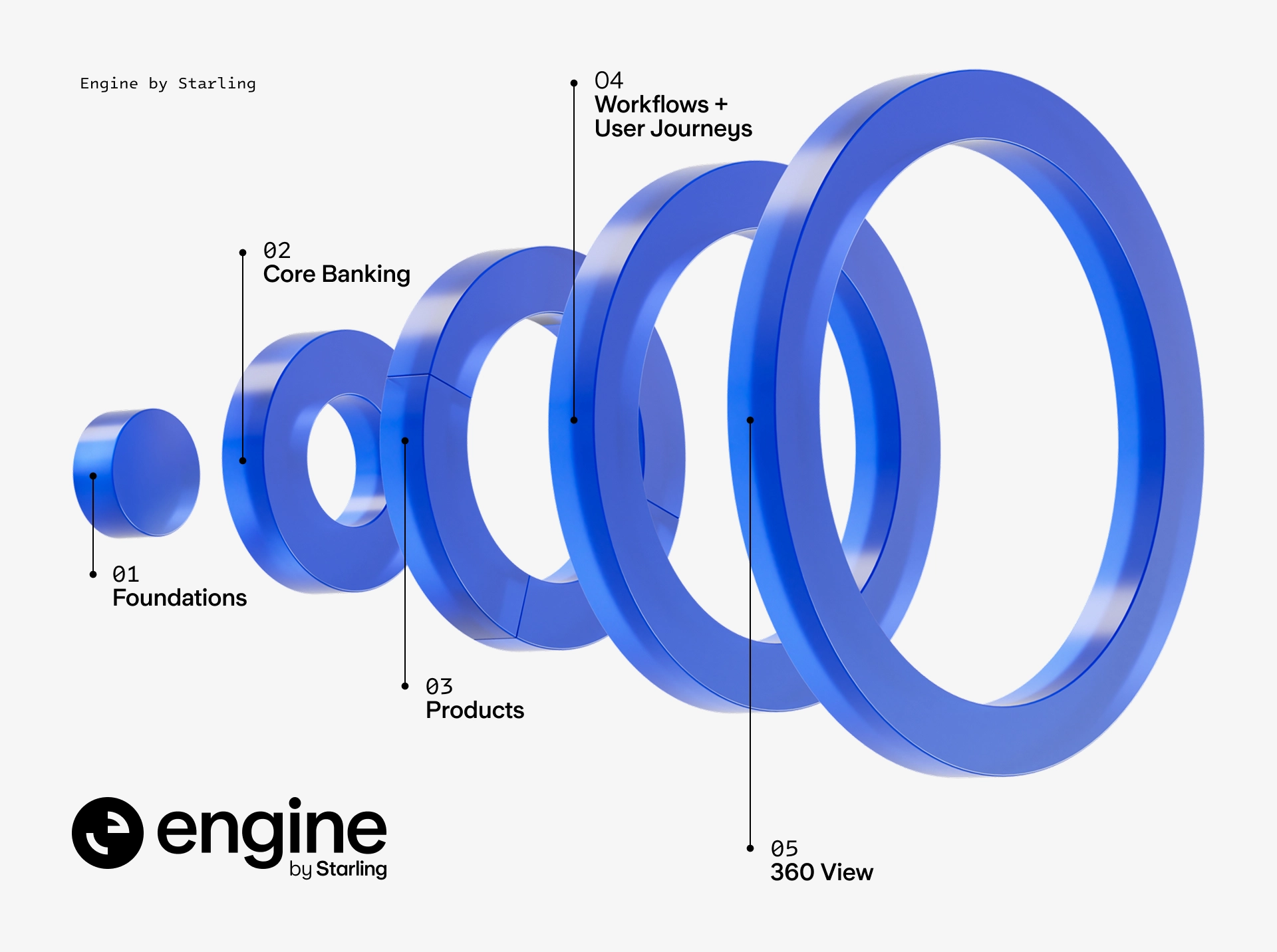
Our modern, cloud-native platform empowers banks to drive a business-led transformation that removes legacy constraints, such as integration friction, data silos, and product innovation bottlenecks. The following pillars illustrate how technology can be used as a strategic asset and protect both sides of the balance sheet.
1. From closed systems to transparent ecosystems
Unlike legacy cores that act as opaque "black boxes," Engine is built on a modular, API-first architecture that turns third-party integration into a native feature rather than a billable hurdle. This cloud-native platform enables banks to adopt an ecosystem banking strategy, selecting "best-of-breed" fintech partners to meet escalating customer expectations and move at the speed of the market rather than a legacy vendor’s roadmap.
Crucially, this modular flexibility does more than unlock market agility; it redefines low risk by directly aligning modernization with supervisory expectations. By replacing rigid legacy stacks with structured APIs and standardized data access, banks gain an "audit-ready" infrastructure that embeds transparency and control right into the operating model. Through Engine’s cloud-native Management Portal, institutions can support more transparent oversight, stronger internal controls, and more efficient regulatory reporting—enhancing their ability to meet evolving supervisory expectations across areas such as ongoing monitoring, vendor diversification, and exit planning. Ultimately, having a documented, interoperable integration protocol ensures that compliance becomes a built-in standard rather than an after-the-fact consideration. By reducing structural dependency, shifting away from static documentation toward dynamic supervision, and enabling true data portability, this transparent, composable architecture strengthens both individual institutional resilience and broader ecosystem stability.
2. Scaling without the overhead
Mid-tier banks need strategic partners that overcome an R&D budget disadvantage versus tier-1 firms. Engine provides a SaaS-based Managed Service that democratizes tier-1 technology. By handling the complexities of cloud infrastructure, security, and continuous updates, Engine allows banks to focus their resources on relationship banking, community growth and a tailored customer value proposition.
To remain relevant in a rapidly evolving landscape, mid-tier banks need to reduce structural dependency risk and modernize their operating foundations. Engine provides the toolkit to do exactly that: transforming core infrastructure from a constraint into a transparent, resilient platform aligned with supervisory expectations.
3. AI-driven adaptive delivery
Scale increasingly requires moving beyond traditional agility toward a more adaptive software development life cycle that embeds AI agents directly into the delivery process. True modernization moves beyond treating AI as a temporary plaster for legacy operational challenges; instead, it helps establish the core foundations for a future AI-native operating model. Boards should prioritize a holistic AI strategy over isolated AI projects. By fundamentally accelerating how you build, optimize, and scale, an adaptive SDLC can directly drive enterprise efficiency, ultimately helping make the company far more attractive for premium acquisition.
Putting a new core into production is only one step on the path to true bank modernization. Lasting value is realized when technology change is aligned with business strategy, operating model evolution, and enterprise‑wide ownership of outcomes. Achieving true modernization requires alignment across the bank—so that the core, processes, people, and governance evolve together to deliver measurable results.
Another frequent failure point is delivery fragmentation: one provider focuses narrowly on the core while other parties separately handle operating model design, process redesign, testing and deployment. This can introduce handoffs that slow delivery, dilute accountability and create misaligned priorities.
Accenture addresses these challenges through an integrated transformation approach that aligns operating model redesign, enterprise architecture, systems integration, testing, and deployment under unified delivery governance. This approach is designed to reduce fragmentation by coordinating cross-functional teams and clarifying end-to-end ownership across the modernization lifecycle. Where appropriate, Accenture applies AI-enabled delivery accelerators to streamline activities such as code and configuration development, test case creation, and documentation. These capabilities can help improve delivery consistency and reduce cycle time while maintaining required controls.
Accenture analysis has identified measurable benefits associated with core transformation, including the potential to improve a bank’s cost-to-income ratio by 5–10 percentage points and reduce time-to-market for new products by up to 75%. Accenture typically positions core modernization as a holistic business transformation enabled by technology. Accenture helps banks define a target “North Star” operating model, assess current-state processes and customer journeys and identify where legacy constraints hinder growth. Programs are commonly delivered in phased, manageable increments, often using modular architectures that allow new components to coexist with legacy systems during transition. Emphasis is placed on process redesign and change management so that platform modernization translates into business outcomes. This approach is compatible with modern core platforms such as Engine by Starling. By combining Engine’s API-first architecture with Accenture’s transformation and delivery capabilities, banks can accelerate time-to-value and reduce integration friction in modernization programs. The intent is to ensure banks modernize not only the core platform, but also the operating model and processes required to realize value from the change.
The M&A wave is not a passing storm; it is a steady drumbeat that will reshape the American mid-tier for the foreseeable future. For leadership teams, the mandate is clear: modernize, not just to survive, but to set the next chapter of business growth.
Regardless of where you place in the growth food chain, modernization should be a tool to consider. By acting with urgency now, you ensure that when the opportunity to acquire or consolidate arises, your technology is an accelerator rather than a handbrake.
For leadership, the choice is clear: continue managing the rising costs and risks of ‘black box’ legacy systems, or pivot toward a modern architecture. The former leads to operational stagnation, the latter slashes overhead and turns IT into a primary source of resilience, efficiency and growth.
Modernize today to become the acquirer of tomorrow. Ensure that if you are acquired, you do so from a position of maximum value and technical strength. In the upcoming wave of consolidation, there is no middle ground. You will either be the architect of the deal or become trapped by technical debt. The choice is yours: be the “efficient” buyer, be the “modern” prize, or be left behind.
Industry and public sources
• Public bank disclosures and regulatory filings referenced throughout the report • Market commentary and announced transaction details cited inline
- Accenture, Banking Trends 2026 (https://www.accenture.com/us-en/insights/banking/accenture-banking-trends-2026)
- Accenture, Pulse of Change Survey (https://www.accenture.com/us-en/insights/pulse-of-change)
- Andrew Wilkie, Legacy technology is limiting bank modernization, CIO, December 3, 2025. (https://www.cio.com/article/4099519/legacy-technology-is-limiting-bank-modernization.html)
Acknowledgement:
This report was authored and published by Engine by Starling. Accenture contributed input in the form of subject-matter perspectives and select research references. Any Accenture research cited herein is attributed to its original source. Accenture did not author this report and no endorsement or co-branding is implied.

President, North America
Engine by Starling
About the author: Jody leads our business in North America for Engine, responsible for driving growth across the region. As a seasoned finance leader, Jody has executed multiple successful digital transformation programs. Previously at Personetics Technologies, Jody has also held senior digital operating roles at U.S. Bank, Citizens Bank, and Wells Fargo.
ContactWant to know more?
Whether you’re launching a new digital bank or migrating from a legacy platform: let’s discuss how Engine can help. Share details about your requirements and we will be in touch.
Are you looking for a Banking-as-a-Service solution in the UK?
Contact Starling’s dedicated B2B team to find out more about the services provided.